

VINYL ROMANCE 1
By D.R. Halliday
A couple of years ago my son David and I were hanging in my office/smoking room, conversing over martinis (the house cocktail) to the accompaniment of a playlist, which had originally been a CD, compiled largely from the vinyl records in my collection. That CD is one of fifty that I compiled over a period of four years (2001-2004) exclusively of piano trios (piano, bass, and drums, the standard modern jazz rhythm section). The rules I imposed upon myself in compiling those fifty discs were few and simple:
a) Fill as much of each disc as possible with a sequence of compelling recordings embodying enough variety to keep the flow of music interesting without succumbing to any “jarring” segues.
b) Don’t include more than one performance by a particular pianist on any one disc.
c) Don’t include more than one performance of a particular song on any one disc.
Those fifty CDs, now conveniently loaded into my laptop, contain over 700 performances, recorded over a 65-year period, featuring 205 jazz pianists from more than 20 countries.
The selection of which pianists to include was entirely a product of my personal tastes, which might be somewhat discernable from the frequency with which each appears on the discs. Here’s a partial breakdown for jazz piano afficionados who might be curious regarding the tastes of a fellow afficionado: of the 205 pianists who appear on the 50 CDs, only 15 make more than 10 appearances, led by Erroll Garner (20 performances), followed by Thelonious Monk (19), Teddy Wilson (18), Paul Bley (17), Tommy Flanagan (16), Bill Evans (15), Brad Mehldau and Oscar Peterson (14 each) Chick Corea (12), Earl Hines and Wynton Kelly (11 each), and Monty Alexander, Duke Ellington, Art Tatum, and Jessica Williams (10 each).
It’s certainly arguable that such pianists as Bud Powell and Keith Jarrett (8 each), Martial Solal (7), McCoy Tyner, Jaki Byard, and Roland Hanna (6 each), and Herbie Hancock and Andrew Hill (5 each) deserve more space than I gave them.
But such arguments among jazz lovers usually promote more solidarity than enmity, attributable to mere Geschmackssache (German: “matters of taste”) and however much my fellow jazz lovers might disagree with me on this or that matter of taste, they’ll doubtless applaud my motive to curate and compile all those discs – a pure labor of love – a love of jazz that extends down into the grooves of all those vinyl records that initially supplied the now-digitized music that David and I were enjoying that night.
As we listened, our conversation unsurprisingly turned to the relative merits of vinyl verses digital recordings.
David was well-equipped for this conversation because, while certainly reliant on digital technology to access the wealth of music available today and to produce and distribute his own music, he is nevertheless a child of the Pre-digital Age of recorded music, whose listening began with vinyl.
Born in 1973, he had his first turntable in 1978, at age five. CD technology would not be introduced until 1982 and CDs would not begin to outsell vinyl records until 1986. And like many, perhaps most, music lovers of the time, David and I resisted investing in this new and relatively expensive technology: I held out until around 1988 and David until 1990, as a high school sophomore.
Even then, our recorded music purchases continued for a time to be mostly vinyl, bought “hands on,” from record stores. There were many record stores in those days, large and small, specializing in both used and new records. Several of the used stores in the San Francisco Bay Area, particularly Village Music in Mill Valley, hold fond memories, but among the larger stores specializing in new records, Tower Records could lay credible claim to being the “gold standard,” and our California residences provided tolerable access to Tower stores in Sacramento, San Francisco, and Concord. David often eagerly accompanied me on my frequent shopping trips to those stores.
About those days (and nights – Tower stores stayed open until midnight) we reminisced fondly as we discussed the question of vinyl versus digital. Compared to other record stores Tower stores were huge, with what seemed an awesome selection of LPs in every imaginable category. “Going into a Tower,” David recalled, “was like walking into a church of music.” And he never got bored while I’d take my time thumbing through the massive selection of jazz albums, which ranged from early recordings by the likes of The Original Dixieland Jazz Band, Jelly Roll Morton, Sidney Bechet, Louis Armstrong, Duke Ellington, James P. Johnson, Fats Waller, Bix Beiderbecke, Johnny Dodds, Fletcher Henderson, Bennie Moten, and Jimmy Noone, through Swing Era greats like Benny Goodman, Count Basie, and Artie Shaw, bebop giants like Monk, Bird, Dizzy, Fats Navarro, and Bud Powell, the hard bop of Horace Silver and Art Blakey, post bop, avante garde, fusion – the entire history of jazz up to the latest releases by Keith Jarrett, Weather Report, The Art Ensemble of Chicago, and Sun Ra. It was all there in the form of vinyl, tucked into one-foot-square liners, many with compelling cover art and informative liner notes as readable as the pages of a large book.
And while I was immersed in this veritable ocean of jazz history, David would explore the entire store, beginning with pop/rock and going on to investigate whatever caught his attention. “One Tower store,” he recalled, “had a separate room entirely dedicated to classical music, with classical music playing inside, and on one wall of each store, always hung the 100 top-selling 45 RPM singles of the week. It’s funny,” David went on, “but no matter how long you took checking out the jazz section, I never got the feeling, ‘Gee, I wish Dad would hurry up’ – I was just always entertained by what there was to see.’”
But, as the title of Colin Hanks’s 2015 documentary on the rise and fall of Tower Records laments, All Things Must Pass. Tower, which opened for business in 1960 in a Sacramento drug store and grew to expand its reach world-wide, declared bankruptcy in 2006. Its demise has been attributed to a number of things, but David and I agreed that the digital revolution – first CDs and then computer downloads and streaming – played a significant role, and vinyl’s demise seemed inevitably to mirror that of Tower Records.
Or did it? Curiously, as David informed me in our conversation, the year 2019 saw vinyl sales again top CD sales. That doesn’t signal the inevitable triumph of vinyl over digital; downloads and streaming will preclude that from ever happening. Still, for us vinyl lovers, this renewed interest in vinyl is welcome news.
A further bit of welcome news is something I’ve observed in recent movies and TV series, where, increasingly, turntables are appearing in the dwellings of the hippest and most sympathetic characters. The prime example is, appropriately enough, Amazon Prime’s series Bosch, which I’d recommend unreservedly to all who share my love of jazz and film noir.
The series is based on the crime novels of Michael Connelly, a gifted and compassionate writer with a deep knowledge of criminality, police procedure, and the city of Los Angeles, the epicenter of film noir, where his novels are set and where he spent three years on the crime beat for the Los Angeles Times. Connelly’s protagonist is the LAPD homicide detective Hieronymus “Harry” Bosch, a hard man with a soft spot for jazz, the sound of which permeates the series soundtrack with recordings by Miles Davis, Sonny Rollins, Eddie “Lockjaw” Davis, Frank Morgan, Coleman Hawkins, Gene Ammons, Red Garland, Jack Teagarden, Ben Webster, Charlie Haden, Hank Jones, Stan Getz, Zoot Sims, Milt Jackson, Grace Kelly, John Coltrane, Ray Barretto, and Art Pepper.
Detective Bosch, through a windfall generated by a successful movie based on one of his cases, has acquired a house that juts out from a hill high above Los Angeles, with a glass wall and a deck that provide an Olympian view of the city and some respite from its myriad urban evils. In his living room, directly behind the glass, on a waist-high cabinet, sits his audio system, including a turntable and another component prominently labeled McIntosh. This setting, particularly at night, with all the lights of the city twinkling in the distance below, provides a near ideal complement to the music of the vinyl records (mostly jazz ballads) that spin on Bosch’s turntable.
That turntable, David and I agreed, is integral to the setting: removing it and replacing it with a CD player or computer or any other digital device would undermine the powerful ambience it adds to the setting, detracting from its – what would be the right word? Magic? Mystery? Mystique? – I finally settled on the word romance, a choice confirmed by the second definition of the word I later discovered in the Oxford Dictionary: “Romance: 2 a quality or feeling of mystery, excitement and remoteness from everyday life: the beauty and romance of the night.”
That definition certainly applies to the setting I’ve been describing of Bosch’s abode high on the hill above the lights of Los Angeles. But both David and I had experienced such a feeling for vinyl long before seeing the Bosch series and, as we continued our conversation, we tried to articulate the reasons – despite the fact that for convenience’ sake the majority of our listening is now digitally generated – vinyl continues to hold that proverbial special place in our hearts. Is it pure nostalgia? Snobbish purism? Or is it something more? Were Bosch to join our conversation, he might flatly state that vinyl is the superior medium.
His preference for vinyl over digital is perfectly articulated in a conversation he has with his teenaged daughter Maddie whom the hard-ass detective loves with a tenderness typical of fathers for their daughters (I know; I have a daughter). The conversation begins immediately after Maddie has listened to a recording Bosch has played for her by Art Pepper of “Patricia,” an original composition that the great alto saxophonist wrote for his own daughter:
Bosch: How’d you like the tune?
Maddie: It was good. I don’t really know anything about jazz, but I liked it.
Bosch: I’ll get you some CDs.
Maddie: I don’t have a CD player. I download all my music.
Bosch: Right. I’ll get you some discs and a CD player. Better yet, I’ll get you some vinyl and a turntable – best way to listen.
“Listen,” David observed, is the key word in Bosch’s evaluation. But “listen” as opposed to what? Simon & Garfunkel provide a useful answer in the lyric of their mid-sixties hit “The Sound of Silence,” which speaks of “people hearing without listening.” The phrase draws a distinction between passive and active perception, between passively “hearing” and actively “listening” – between a kind of diffuse awareness of an auditory stimulus and a purposeful, focused concentration on that stimulus. It is the latter that yields the ultimate gratification we derive from recorded music, and vinyl, while perhaps less convenient than digital, provides the superior way to achieve that gratifying result, not only in the warmer, more inviting sound that vinyl produces but also in the preparation involved in listening to a vinyl record.
Which requires more than merely pressing a couple of buttons. You must first hold the record, protected by its liner and inner sleeve, in your hands, remove the record itself from said liner and inner sleeve, pick the side of the record you wish to hear, place the record on the turntable, lift the tone arm, and lower it precisely on the record’s desired groove.
This preparatory process, as my wife Jill joined our conversation to point out, is tactile in nature, adding a sensory dimension, absent from digital playback, to our anticipation of the music to come. This enhanced anticipation tends to oblige us to focus more closely on the music itself. It’s the same principle as grinding whole beans for coffee rather than sticking a pod in your Keurig machine and pressing a button or preparing a meal from fresh ingredients rather than slapping a frozen TV dinner into the microwave and pressing another button – immediate gratification deferred, ultimate satisfaction enhanced – foreplay.
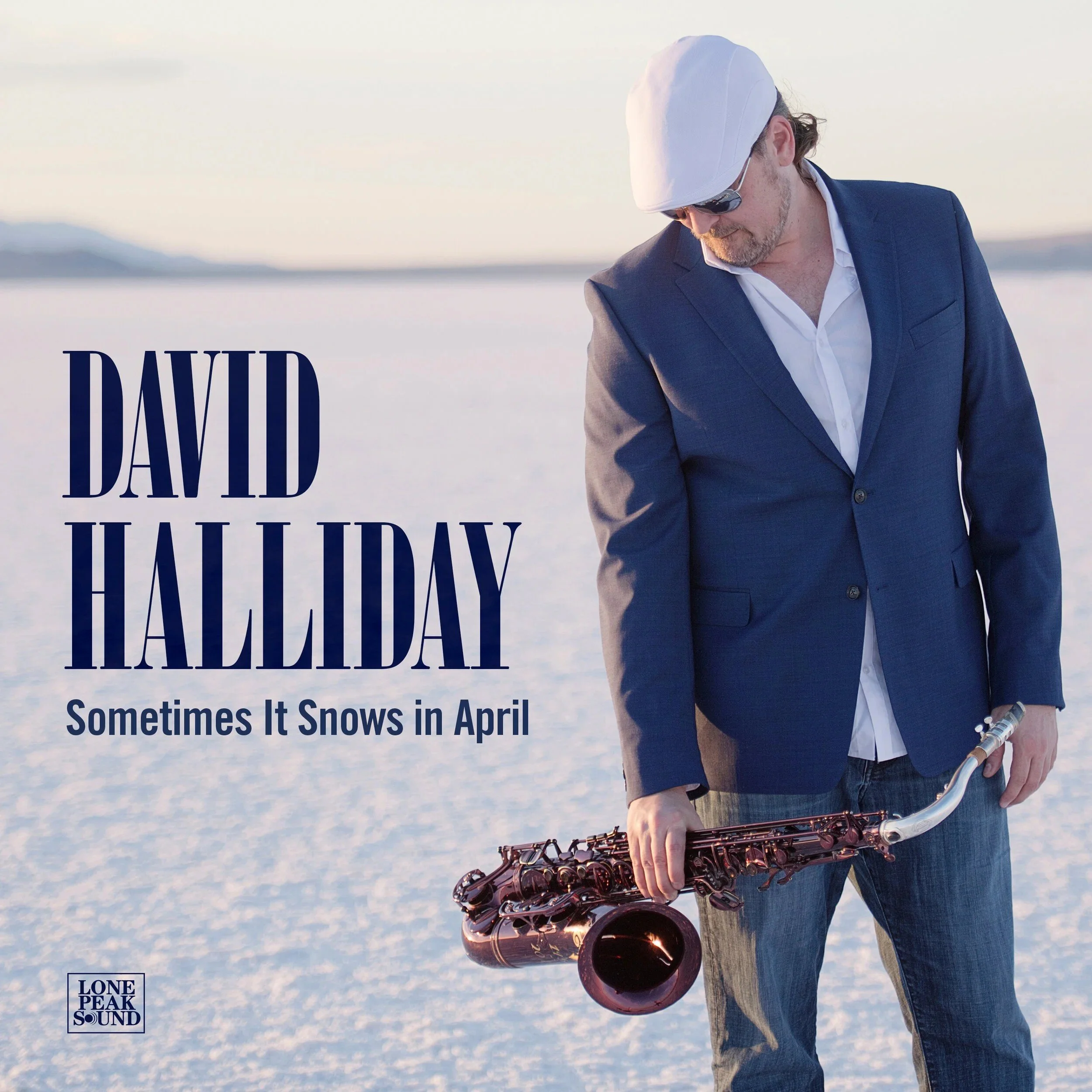
Eventually, as David and I continued discussing this subject, he suggested I write about it, say, a series of columns or blog posts that he’d be happy to add to his Lone Peak Sound website. We considered a series of columns or short posts, each consisting of my musings on one vinyl record of significance in my life. Since I own thousands, that sounded like a fairly easy and enjoyable task but due to other responsibilities and my own sloth, I put that task off until now, when the imminent release of David’s new album Sometimes it Snows in April (on vinyl!) seemed to demand that I either put up or shut up.
Only the choice of a title for my planned series of posts was lacking but, recalling Bosch’s hillside retreat and the Oxford definition of “romance,” cited earlier, i.e., “a quality or feeling of mystery, excitement and remoteness from everyday life: the beauty and romance of the night,” that choice seemed inevitable. Hence, Vinyl Romance.
Reflections on particular vinyl records significant in my personal experience will provide the content of future columns . . .